LabInsights.com
About the project
Date:
Mar 9, 2025
Client:
Roche
Services:
UI/UX
Project Details
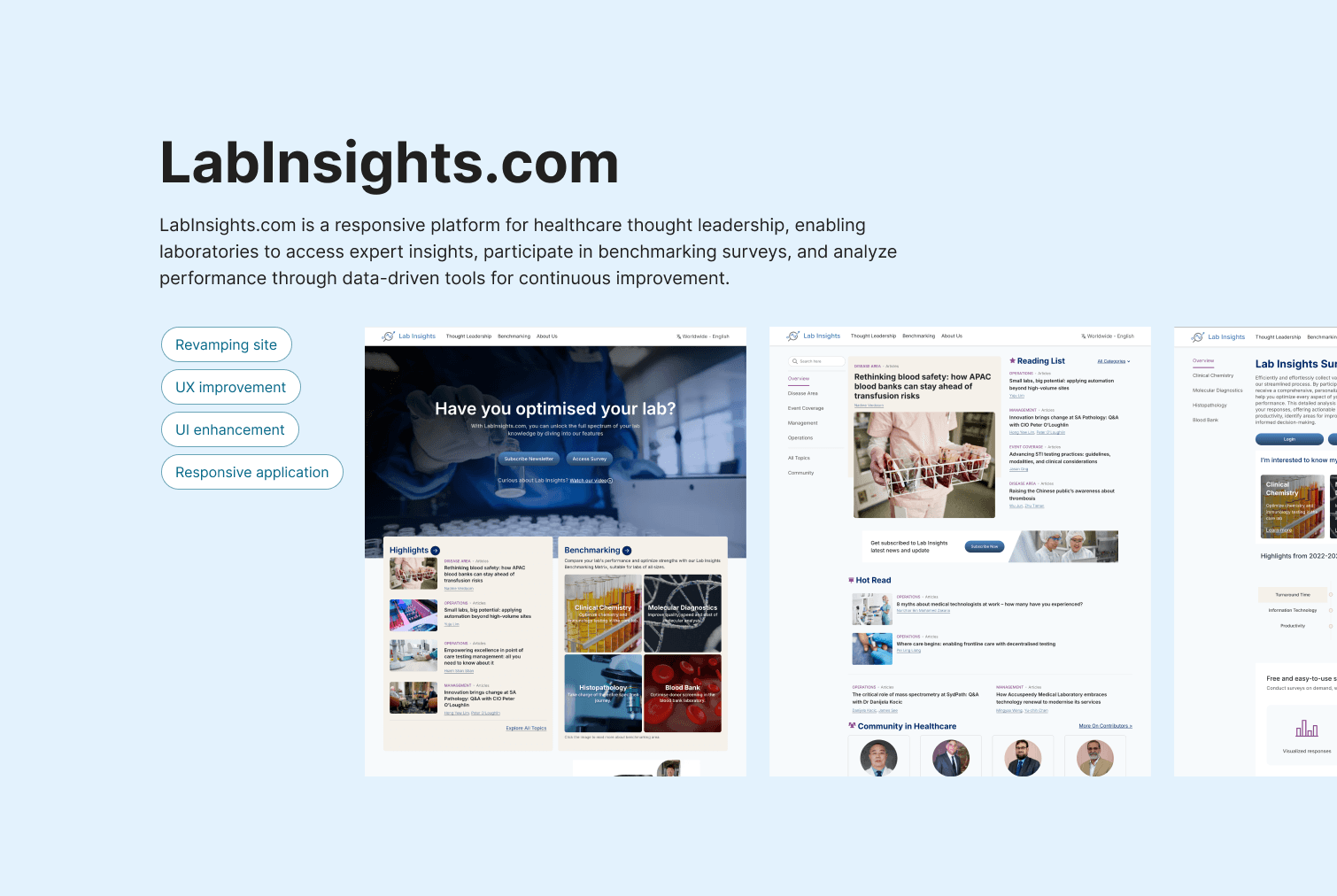
LabInsights.com is a platform focused on healthcare thought leadership and benchmarking for laboratories. It caters to two distinct user groups:
Public Users – who browse insights, articles, and webinars.
Registered Benchmarking Participants – who contribute data and receive personalized dashboard analyses to improve their lab performance.
However, these experiences existed on two different platforms (CMS + custom dashboard) with inconsistent visuals, interaction patterns, and technical constraints. Users experienced friction navigating between the two, which negatively impacted engagement, trust, and comprehension—especially across multilingual regions.
It's impressive how she tackled a new challenge head-on, leveraging example from Tableau domain and counter with Accenture developers for feasibility checks. Her effort has significantky ramped up the efficiency of our product lifecycle
Jeanette Wu
Lab Consulting Manager
Things I Did
I was tasked to:
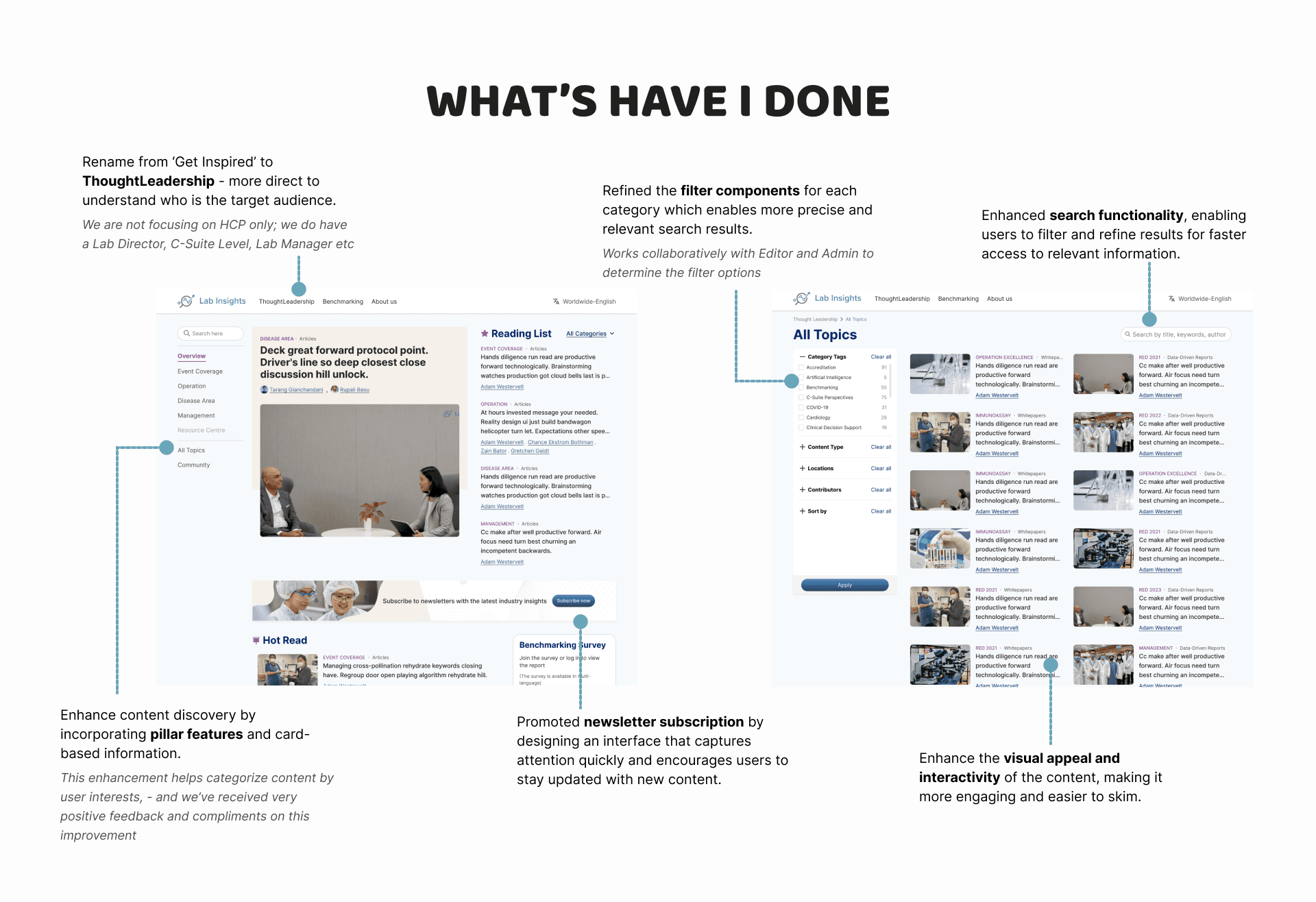
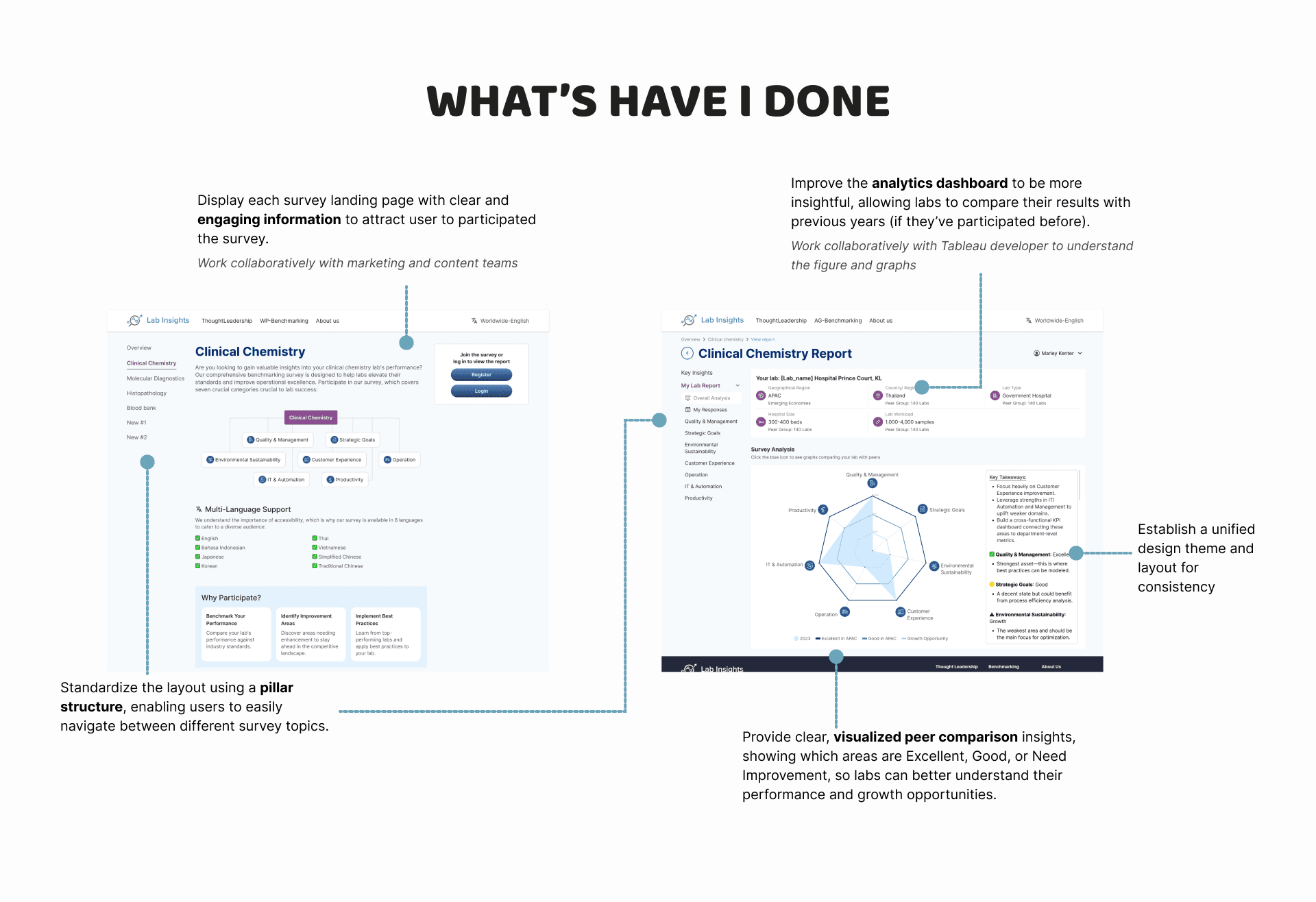
Revamp the user experience to unify the feel between the public content site and the benchmarking dashboard.
Improve user engagement and reduce bounce rate.
Create a scalable, multilingual-ready design system that could work across both technical frameworks while meeting user and business needs.
My actions:
Mapped User Journeys & Identified Pain Points
Conducted collaborative sessions with stakeholders and end-users to understand the current journeys. Noted friction points from both user experiences (confusing navigation, inconsistent branding) and business goals (poor content visibility, low dashboard engagement).Conducted A/B Testing for Design Validation
Developed multiple design directions for critical touchpoints and ran A/B testing to assess clarity, efficiency, and goal achievement. These results informed decisions on layout, hierarchy, and CTA placement.Developed Wireframes & Prototypes
Translated ideas into low- and high-fidelity wireframes and interactive prototypes using Figma. These became central tools for cross-functional collaboration, helping teams visualize flows, interactions, and component behaviors.Balanced Design with Technical Feasibility
Held weekly sessions with tech teams to review the feasibility of proposed designs, especially considering both platforms' limitations. Worked closely with developers to find creative solutions that respected constraints but didn’t compromise on user experience.Created a Unified Design System
Established a cross-platform design system covering typography, color, grid, reusable components, and responsive behaviors. This ensured a consistent experience across public and dashboard platforms, even though they used different frameworks.Collaborated Across Departments
Worked closely with the SEO team to ensure visuals were lightweight and crawlable, the QA team to test UI consistency, and stakeholders to align designs with policy requirements (especially for multilingual audiences).
As the results:
✅ Engagement rate increased from 46% to 81%
✅ Bounce rate reduced by 50%, showing better content flow and retention
✅ Unified visual identity and design experience across both platforms
✅ Successfully enabled multi-language support, improving accessibility for APAC markets
✅ Created a scalable design system that continues to support future features
My Lesson Learn
Designing for multilingual support from the start ensures usability and inclusivity across diverse regions, minimizing rework and enhancing global reach.
Working under tight, iterative timelines—delivering three different products within every 3-week sprint—reinforced the importance of prioritization, rapid prototyping, and making informed design decisions efficiently.
Establishing a unified user experience across multiple frameworks required close collaboration with developers to ensure technical feasibility, maintain consistency, and deliver seamless performance across platforms.
A well-structured design system and stakeholder alignment are critical in bridging fragmented systems, allowing for scalability and cohesive UX across complex environments.
Effective dashboards go beyond displaying data—they should deliver clarity, highlight actionable insights, and increase user engagement through intuitive design.
Continuous collaboration with SEO and technical teams helps balance aesthetic, performance, and discoverability, supporting both user satisfaction and platform visibility.